

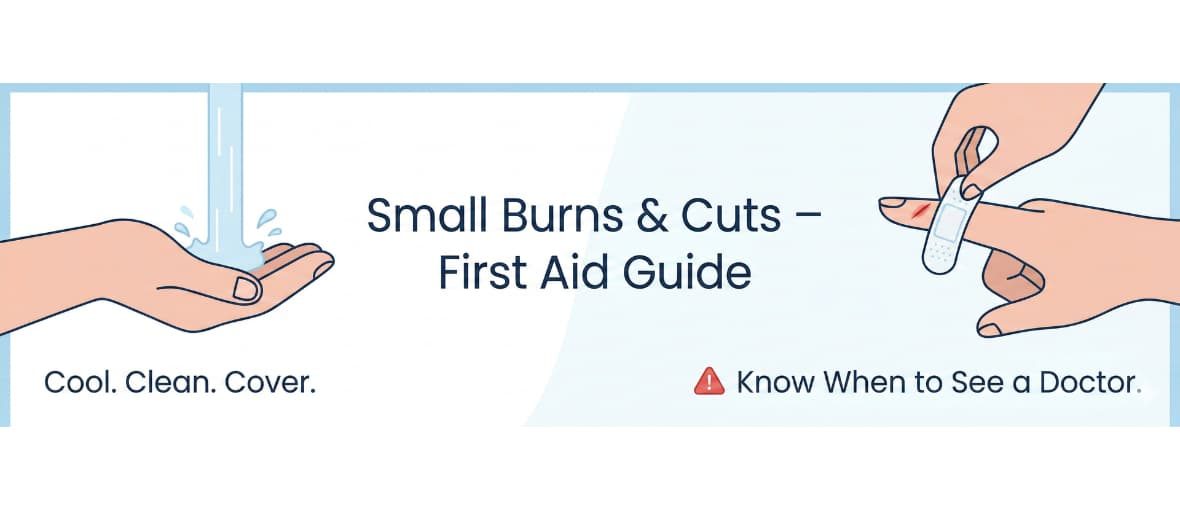
“Quick care can make all the difference. For burns or cuts, cooling, cleaning, and protecting the skin are the first steps—but knowing when to seek professional help is just as important. At Ucare Pharmacy, we provide the products and advice to help your injuries heal safely and effectively.”
1.Burns
A burn is a skin lesion caused by contact with a flame, liquid or hot object, electric current or corrosive product. Unclogs, descalers, salt spirit, bleach, ammonia are examples of corrosive products.
1/ Cooling the burn is always the priority gesture!
Cooling eliminates heat, isolates the wound from ambient air, relieves pain, cleans the burn and limits its extension to the surface and depth.
Cool the burn…
✓ As quickly as possible.
✓ With running water, preferably warm, under a tap, a shower, a garden hose.
✓ By directing the water jet so that the water flows on the burn (above the burn and not directly on the burn).
✓ For at least 20 minutes.
✓ Remove the clothes around the burn provided they do not stick to the skin.
X Do not use ice to cool the burn.
2/ Evaluate the severity of the burn to adapt the care
In case of a simple burn (small and shallow)
✓ Apply an ointment for the care of burns and a sterile non-adherent dressing, or a bandage adapted to the care of burns to protect the burn.
X Do not pierce the blisters.
Ask your pharmacist for advice to compose your first aid kit
In case of severe or extensive burn
✓ Call the hospital for first aid and transportation of the victim.
✓ Sit the person as comfortably as possible.
✓ Cover the wound with a bandage or a damp clean cloth.
X Do not give anything to drink or eat while waiting for help and make sure that the victim does not catch a cold.
X Do not apply ointment or disinfectant to burns.
X Do not give painkiller, In case of chemical burn
✓ Rinse the skin with water for 30 to 60 minutes.
Severity of burns
Depending on the depth of the burn, we will speak of 1st, 2nd or 3rd degree burn, or more simply superficial or deep burn. The depth of the burn determines its severity. A burn has a different appearance and is more or less painful depending on its degree:
Superficial burn: The skin is red and the burn is painful. If the skin does not have wounds or blisters, it is a 1st degree burn. The typical example is sunburn. If wounds or blisters are present, it is a superficial 2nd degree burn.
Deep burn:
The skin is pale with burst blisters (2nd degree deep) or white and blackish (3rd degree). The nerves are affected and the burn is therefore not very painful. The severity of a burn depends not only on its depth, it also depends on other factors such as its size or location.
The consequences of a burn can also be more serious in a child, an elderly person or a person with a chronic illness, such as diabetes, diseases that affect the heart, lungs, kidneys or immune system.
These different factors will determine whether you can treat the burn yourself, whether you need to consult your doctor or be taken care of in an emergency department or a service specialized in the treatment of burns.
Call on an emergency service or a service specialized in the treatment of burns for:
- Deep burns, regardless of size, even if the burn appears generally not serious. Large superficial burns, for example on an entire arm or leg.
- Superficial burns located on the face, hands, feet, large joints (armpit, back of the knee), genitals, around the anus or that go around an arm or leg.
- Burns caused by chemicals.
- Superficial burns larger than the surface of the victim’s hand in an elderly person, a young child or a person with a chronic disease.
Slight superficial burns can be treated outside the hospital. Ask your pharmacist for advice. If the burn is larger than half of the victim’s hand, or a 2cm diamter coin in a young child or an elderly person, it is advisable to consult a doctor.
If you have any doubts about the severity of the burn, consult your doctor or pharmacist.
2. First Aid for Small Cuts
Stop Bleeding
- Apply gentle but firm pressure using sterile gauze or a clean cloth.
- Maintain pressure for 5–10 minutes without frequently checking.
- If bleeding continues, elevate the injured area above heart level if possible.
- Avoid repeatedly removing the gauze, as this may disrupt clot formation.
Clean the wound
- Clean running water (for initial rinsing)
- Normal Saline (0.9% Sodium Chloride) preferred for wound irrigation
- Sterile saline wound wash spray
Irrigate thoroughly to remove:
- Dirt
- Debris
- Foreign particles
Use moderate flow pressure, but avoid forceful scrubbing that may damage tissue.
After irrigation, apply a suitable antiseptic.
Recommended antiseptics:
- Povidone-iodine solution (e.g., 10%)
- Chlorhexidine solution (0.05%–0.1%)
- Mild antiseptic wound solution recommended by your pharmacist
- Hydrogen Peroxide:
Hydrogen peroxide (3%) may be used only for initial cleaning of visibly contaminated wounds, but:
- It can damage healthy tissue
- It may delay wound healing
- It should NOT be used repeatedly
Cover the Wound properly
- Use active dressings
- Or cover with oily tulle, then a sterile compress or adhesive bandage (plaster) for small cuts
- For slightly larger wounds, use sterile gauze secured with medical tape
- Ensure the dressing is breathable but protective
Ongoing Care
- Change dressing once daily or if wet/dirty
- Keep the wound clean and dry
- Monitor for infection signs:
- Increasing redness
- Swelling
- Warmth
- Pus
- Fever
Most minor cuts heal within 5–7 days.
3. Alarm Signs – When to See a Doctor Immediately
Even small injuries can become serious if not treated properly.
Seek medical attention if you notice:
For Burns:
- Burn is larger than your palm
- Deep wound or white/black skin
- Severe pain
- Signs of infection (pus, swelling, fever)
- Burn on face, hands, feet, or genitals
For Cuts:
- Bleeding doesn’t stop after 10 minutes of pressure
- Deep wound or edges widely open
- Caused by dirty or rusty object
- Redness spreading around the wound
- Fever or pus
How Our Ucare Pharmacy Can Help
At our pharmacy, we provide:
✔ Wound cleaning solutions
✔ Burn creams
✔ Sterile dressings & bandages
✔ Professional advice on proper wound care
If you’re unsure whether your injury is minor or serious, consult our pharmacist for guidance.